

1. About This Course
 This half-day course provides practical safety and security training for personnel and companies involved in the road transport of radioactive material. It covers the period before departure, the journey, secure handover and the response to safety or security events. The emphasis is on usable actions: checking packages, vehicles, documents and contacts; protecting sensitive transport information; recognising reportable concerns; maintaining control at handover; and activating approved response arrangements when something goes wrong.
The curriculum draws on South African regulatory and guidance material, including the Regulations Relating to Group IV Hazardous Substances (R.247) and the SAHPRA Guideline for Transportation Security for Radioactive Material (RN-20), together with relevant IAEA transport safety, radiation protection and nuclear security guidance.
2. About the Presenters
Dr Tobias Kotzé
Dr Tobias Kotzé is an HPCSA-registered medical physicist and radiation protection consultant. He formerly served as deputy director of the Radionuclide sub-directorate at the Directorate Radiation Control, worked in the Medical Physics Division at Groote Schuur Hospital, and has extensive experience in radiation regulation, professional training and clinical medical physics. He serves on the SAHPRA Technical Advisory Committee for radiation-protection matters and is a member of the IRPA Task Group on Radiation Protection Education and Training.
Dr Christiaan Kotzé
Dr Christiaan Kotzé is a medical practitioner with experience in emergency and acute care. He holds a bachelor’s degree in Physics and Applied Mathematics and is completing postgraduate studies in radiation and health physics. His clinical background contributes practical perspectives on time-sensitive decision-making, structured escalation, communication under pressure and protection of patients, staff and the public.
3. Who Should Attend
Radiation Protection Officers; drivers and dispatch personnel involved in transporting radioactive material; authority-holder staff with transport responsibilities; and healthcare personnel involved in the preparation, oversight, receipt, use or road transport of radioactive material. This includes medical physicists, radiographers, radiation laboratory technologists, medical practitioners and other relevant registered healthcare professionals.
4. Course Benefits
- Connect radiation safety and transport security requirements with practical responsibilities before, during and after a journey.
- Improve pre-trip checking of package identity, labels, placards, transport documents, locks, seals, restraint, communications and emergency contacts.
- Clarify the respective responsibilities of drivers, Radiation Protection Officers, authority holders, dispatch staff, receivers and subcontracted carriers.
- Strengthen recognition and reporting of suspicious behaviour, tampering, route deviation, delay, communication failure, non-receipt, theft and loss of control.
- Practise a disciplined response to collisions, fire, breakdowns, failed handovers and other off-normal events without improvising beyond the participant’s responsibilities.
- Receive course notes, practical checklists and supporting transport-security resources and templates that comply with SAHPRA regulations.This presentation provides training for radiologists, radiographers and other relevant medical staff in dose optimisation in mammography. It fulfils the regulatory requirement of the Directorate Radiation Control (SAHPRA).
5. Presentation Outline
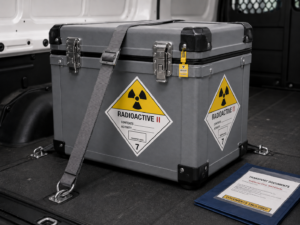
Training on road vehicle transport safety and security training for radioactive material
5.1 Basic Transport Safety
Topics include:
- Safety and security in practice
- Radiation awareness
- Time, distance and shielding
- Packages, labels and transport index
- Placards and documents
- Segregation, restraint, storage limits and pre-trip checks.
5.2 Why Transport Security Matters
Topics include:
- Transport vulnerabilities
- Prudent, basic and enhanced security management
- Contingency planning
- Trustworthiness
- Information protection
- Transport Security Plans and subcontractor responsibilities.
5.3 Driver Security Responsibilities
Topics include:
- Detection, delay and response
- Vehicle, load, route and stop discipline
- Communications and tracking
- Suspicious enquiries
- Authorised handover
- Non-receipt and immediate reporting.
5.4 RPO Security Responsibilities
Topics include:
- Support to the authority holder
- Procedures, records and training evidence
- Testing contact arrangements
- Information control
- Transport Security Plan implementation
- Incident review and corrective action.
5.5 Real Incidents and Lessons
Topics include:
- Loss of control and delayed reporting
- Vehicle theft and missing radioactive material
- Public access, tampering and source recovery
- Lessons for drivers, RPOs and organisations.
5.6 When Something Goes Wrong
Topics include:
- Collision, fire and breakdown
- Tampering, missing material and suspicious activity
- Communication failure and route deviation
- Failed handover and unavailable recipients
- Protect, secure, communicate and escalate.
6. Assessment
A facilitator-supervised multiple-choice questionnaire tests the stated learning outcomes. Attendance and assessment results are retained for each presentation.
7. Course Fee
Course fee for 2026:
R2 750.00 + R412.50 (VAT) = R3 162.50
The course fee includes detailed course notes and draft templates for documentation as required by SAHPRA.
8. Course Certificates
The course material is in accordance with the IAEA guidelines for road vehicle transport safety and security training for radioactive material.
Attendance of this radiation safety training course can be submitted to the Directorate Radiation Control for their consideration to recognize it as training for road vehicle transport safety and security training for radioactive material.
Attendance Certificate:
An attendance certificate will be issued to all delegates attending and will be emailed to delegates after the course.
Knowledge Certificate:
A knowledge certificate will be issued to those delegates who have passed an online written test at the end of the course. The knowledge certificate will be emailed to delegates after the course.
9. Downloadable Documents
Agenda – Road Vehicle Transport Safety and Security Training
Registration form – Road Transport Security 2026 (Excel)
Registration form – Road Transport Security 2026 (Pdf)